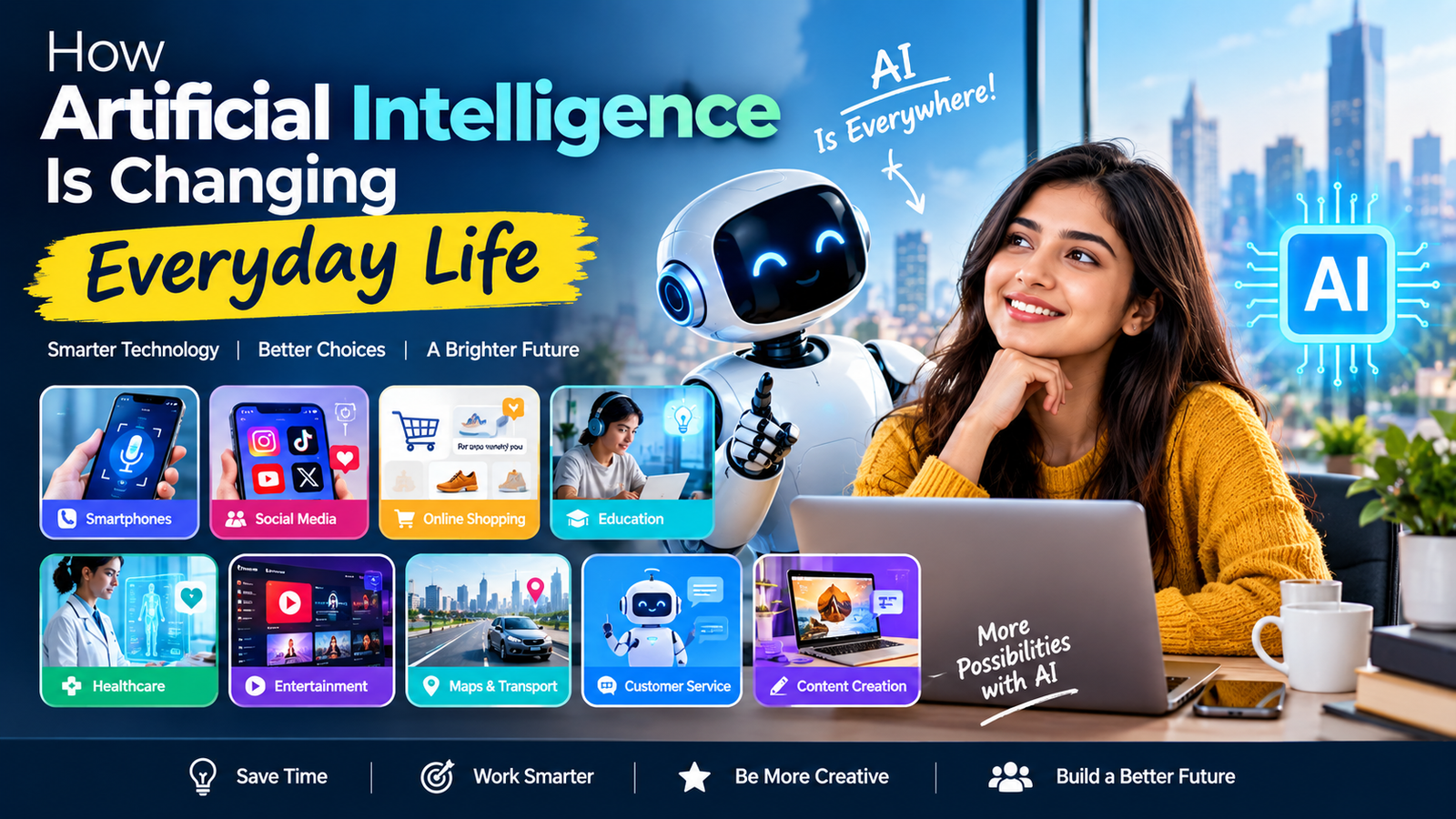
Artificial Intelligence, commonly known as AI, has quickly become part of everyday life. From the recommendations we see on social media to voice assistants, online shopping, navigation apps, and smart devices, AI is working behind the scenes in many of the technologies we use every day.
Many people think of AI as something futuristic, but it is already being used in ordinary activities. How Artificial Intelligence Is Changing Everyday Life is an interesting question because AI is not limited to robots or advanced laboratories anymore. It is becoming a practical technology that helps people search, learn, communicate, create, and make decisions.
In this article, we will explore how AI is changing different parts of our daily lives and what its future could look like.
What Is Artificial Intelligence?
Artificial Intelligence is a branch of technology that allows computer systems to perform tasks that normally require human-like abilities, such as recognizing patterns, understanding language, analyzing information, and generating content.
AI systems can process large amounts of information and use patterns in that information to produce predictions, recommendations, or responses.
For example, when a video platform recommends a video based on what you have watched before, an AI system may be involved in generating those recommendations.
How Artificial Intelligence Is Changing Everyday Life
AI is becoming part of many everyday activities. Sometimes we interact with it directly, while other times it works quietly in the background.
Let’s look at some important examples.
1. AI in Smartphones
Smartphones are one of the easiest places to see AI in action.
Modern phones use AI-related technologies for features such as:
- Voice recognition
- Face or image recognition
- Camera enhancement
- Predictive text
- Spam detection
- Personalized recommendations
- Battery optimization
When a smartphone camera automatically improves an image or recognizes objects in a photograph, machine-learning technology may be helping with the process.
Voice assistants can also understand spoken commands and provide information, set reminders, or perform supported actions.
2. AI in Social Media
Social media platforms use algorithms and machine-learning systems to personalize what users see.
For example, your feed may be influenced by factors such as the content you interact with, topics you follow, and videos or posts you spend time viewing.
AI can also help platforms identify spam, detect potentially harmful activity, recommend accounts, and organize large amounts of content.
This means that AI plays an important role in shaping the digital experience people have on social platforms.
3. AI in Online Shopping
AI has significantly changed online shopping.
When you browse an online store, you may see recommendations such as:
“You may also like” or “Recommended for you.”
These suggestions can be generated using algorithms that analyze patterns in browsing and purchasing activity.
AI can also help businesses manage inventory, answer common customer questions through chatbots, detect suspicious transactions, and improve search results.
For customers, this can make it easier to discover products that match their interests.
4. AI in Education
Education is another area where AI is creating new possibilities.
Students can use AI-powered learning tools to understand difficult concepts, practice skills, organize information, and receive explanations.
Teachers and educational organizations can also use AI tools for tasks such as creating learning materials, analyzing information, and supporting personalized learning.
However, AI works best as a learning aid rather than a replacement for genuine understanding. Students still need to think critically, verify information, and develop their own skills.
5. AI in Healthcare
AI is also being explored and used in healthcare for tasks such as analyzing medical images, identifying patterns in health data, supporting research, and assisting with administrative work.
For example, AI-based systems can help healthcare professionals analyze large datasets more efficiently.
However, healthcare decisions require qualified professionals and appropriate clinical evidence. AI tools should support professional judgment rather than automatically replace it.
6. AI in Entertainment
AI has changed the way people discover and consume entertainment.
Streaming platforms can recommend movies, shows, songs, or other content based on viewing or listening patterns.
AI can also be used in areas such as:
- Game development
- Animation
- Visual effects
- Music technology
- Content recommendations
- Image and video tools
For creators, AI can provide new ways to experiment with ideas and speed up certain parts of creative workflows.
7. AI in Maps and Transportation
Navigation apps have become much smarter with the help of data analysis and AI-related technologies.
They can analyze traffic information and provide route suggestions based on current conditions.
AI can also contribute to transportation systems by helping with traffic management, route planning, logistics, and research into automated driving technologies.
This can make transportation systems more efficient and help people make better travel decisions.
8. AI in Customer Service
Have you ever opened a website and seen a chat window asking if you need help?
There is a good chance that the system may be powered by a chatbot or another automated customer-service technology.
AI-powered systems can answer common questions, guide users through basic processes, and provide information at any time.
For more complicated problems, human customer-service representatives may still be necessary.
9. AI and Content Creation
One of the most visible recent developments has been the use of AI for content creation.
Modern AI tools can assist with:
- Writing and brainstorming
- Image generation
- Video production
- Presentation creation
- Coding assistance
- Translation
- Summarization
These tools can help people explore ideas faster, but the quality of the final result still depends heavily on human judgment, editing, and fact-checking.
Benefits of Artificial Intelligence
AI can provide several benefits when it is used responsibly.
Saves Time
AI can automate repetitive tasks and help people process information more quickly.
Improves Personalization
AI can provide recommendations and experiences based on patterns in user activity.
Helps Analyze Large Amounts of Data
Computers can process enormous datasets much faster than humans can manually examine them.
Supports Creativity
AI tools can help people brainstorm, experiment, and develop creative projects.
Automates Repetitive Work
Businesses can use AI to handle certain repetitive processes, allowing employees to focus on tasks requiring human judgment and communication.
Challenges of Artificial Intelligence
Despite its benefits, AI also creates important challenges.
Accuracy
AI systems can sometimes produce incorrect or misleading information. Important information should therefore be checked against reliable sources.
Privacy
AI systems may process large amounts of data, making privacy and responsible data handling important considerations.
Bias
AI systems can reflect problems present in the data used to develop them. Careful testing and oversight are necessary.
Changing Jobs and Skills
Automation may change how some jobs are performed. As technology develops, learning new digital skills can become increasingly important.
The Future of Artificial Intelligence
AI is likely to become even more integrated into everyday technology.
Future developments could bring smarter digital assistants, improved educational tools, more advanced healthcare applications, better transportation systems, and new creative technologies.
However, the future of AI will not depend only on technological progress. Questions about privacy, safety, accuracy, fairness, copyright, and responsible use will also remain important.
The goal should be to use AI in ways that provide useful benefits while keeping people involved in important decisions.
Conclusion
How Artificial Intelligence Is Changing Everyday Life can be understood by looking at the technology we already use every day. From smartphones and social media to education, shopping, entertainment, healthcare, and transportation, AI is becoming part of many ordinary activities.
AI can save time, analyze information, personalize experiences, and support creativity. At the same time, it is important to understand its limitations and use it responsibly.
Artificial Intelligence is not simply a technology of the future. It is already changing the way people interact with technology today, and its role is likely to continue growing in the years ahead.https://kakshaclasses.com/