Have you ever looked out of an airplane window and wondered how airplanes stay in the sky? An airplane may weigh hundreds of tons, yet it can travel smoothly through the sky. The secret lies in the combination of aerodynamics, lift, thrust, drag, and weight.
Understanding how airplanes stay in the sky helps us appreciate the science and engineering behind modern aviation. Every part of an airplane, from its wings to its engines, has an important role in keeping it safely in flight.
What Makes an Airplane Fly?
These forces work together to explain how airplanes stay in the sky during different stages of flight.
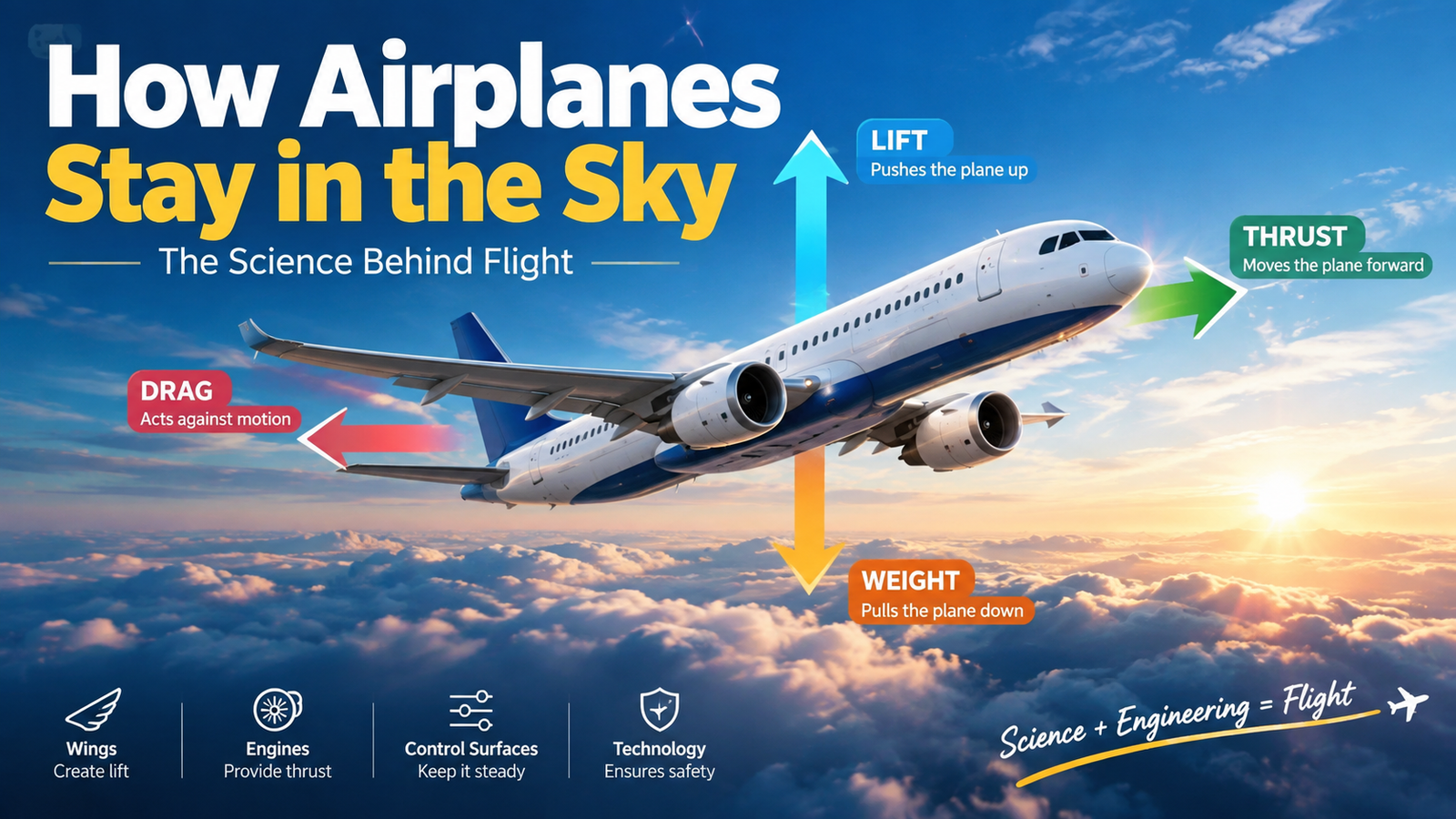
- Lift—pushes the airplane upward.
- Weight—pulls the airplane downward because of gravity.
- Thrust—moves the airplane forward.
- Drag—acts against the airplane’s forward movement.
For an airplane to remain in level flight, these forces need to be balanced. Lift generally balances weight, while thrust balances drag.
This balance is one of the main answers to the question of how airplanes stay in the sky.
1. Lift: The Force That Keeps an Airplane Up
Lift is one of the most important factors in understanding how airplanes stay in the sky.. The wings are specially designed to generate this force.
An airplane wing has a curved shape called an airfoil. As the airplane moves forward, air flows around the wing. The shape and angle of the wing influence the airflow and create a pressure difference that contributes to lift.
The faster the airplane moves through the air, the more lift its wings can generally produce, assuming other conditions remain suitable.
This is why airplanes need to reach a certain speed during takeoff before they can leave the runway.
2. Thrust: Moving the Airplane Forward
Thrust provides the forward motion needed to generate lift and explains another important part of how airplanes stay in the sky.
This is where thrust comes in.
Commercial airplanes commonly use jet engines. A jet engine takes in air, compresses it, mixes it with fuel, and produces rapidly moving exhaust gases. The resulting reaction creates thrust that pushes the airplane forward.
As the airplane gains speed, air flows over its wings and creates enough lift for takeoff.
So, when asking how airplanes stay in the sky, thrust is an important part of the explanation because it provides the forward motion needed to generate lift.
3. Weight: The Force Pulling the Airplane Down
Every airplane is affected by Earth’s gravity. The force of gravity acting on the airplane is called its weight.
Weight includes the airplane itself, passengers, luggage, fuel, and other equipment.
During normal level flight, the lift generated by the wings counteracts the airplane’s weight. If the aircraft needs to climb, the forces are adjusted so that the airplane gains altitude.
The careful management of these forces allows pilots to control the aircraft during different stages of flight.
4. Drag: Resistance From the Air
As an airplane moves forward, it experiences resistance from the surrounding air. This resistance is called drag.
Drag works against the airplane’s motion. Engineers design aircraft to reduce unnecessary drag by creating smooth surfaces and carefully shaped wings and bodies.
However, some drag is unavoidable. The engines must produce enough thrust to overcome it.
The relationship between thrust and drag is another important part of understanding how airplanes stay in the sky.
How Do Airplane Wings Work?
Airplane wings are not simply flat pieces of metal. Their shape is carefully engineered to interact with moving air.
When an airplane travels forward, air moves around the wing. The wing’s shape, angle, speed, and airflow conditions all influence the amount of lift produced.
Modern aircraft may also have flaps and slats on their wings. These movable parts can change the wing’s aerodynamic characteristics.
During takeoff and landing, flaps can help an airplane generate more lift at lower speeds.
How Does an Airplane Take Off?
Takeoff is the stage when the airplane transitions from being on the ground to flying through the air.
First, the engines generate thrust and the airplane begins accelerating along the runway. As its speed increases, air flows faster around the wings.
When sufficient lift is produced, the airplane can leave the runway.
The pilots then adjust the aircraft’s attitude and control surfaces to establish a safe climb.
This entire process demonstrates the interaction between thrust, lift, weight, and drag.
How Does an Airplane Stay at High Altitudes?
After takeoff, an airplane continues climbing until it reaches its planned cruising altitude.
At cruising altitude, the aircraft typically travels at a high and relatively steady speed. The engines provide enough thrust to overcome drag, while the wings generate enough lift to support the airplane’s weight.
Modern airplanes also use sophisticated computers and instruments to help pilots monitor speed, altitude, direction, engine performance, and other important information.
How Do Pilots Control an Airplane?
Pilots use several control surfaces to change the aircraft’s movement.
Ailerons
Ailerons are located on the wings and help control roll, which is the movement that tilts the airplane from side to side.
Elevators
Elevators are located on the tail and help control pitch, which moves the nose upward or downward.
Rudder
The rudder helps control yaw, which moves the nose to the left or right.
Together, these control surfaces allow pilots to guide the airplane through the sky.
Why Don’t Airplanes Simply Fall?
This is one of the simplest ways to understand how airplanes stay in the sky.
The answer is that the airplane’s wings continuously produce lift while the aircraft is moving through the air. As long as the aircraft maintains appropriate flight conditions, the lift can support its weight.
However, flight depends on many factors, including speed, altitude, aircraft configuration, weather, and airflow. Pilots are trained to monitor these conditions and respond appropriately.
The Role of Modern Technology
Today’s airplanes are the result of decades of research and engineering. Modern aircraft use advanced materials, aerodynamic designs, navigation systems, sensors, and flight-control technology.
Aircraft manufacturers use computer simulations and wind-tunnel testing to study how airplanes behave in different conditions before aircraft enter regular service.
These technologies help engineers improve aircraft efficiency, performance, and safety.
The Future of Airplanes
Aviation continues to evolve. Researchers and companies are exploring more efficient engines, lighter materials, sustainable aviation fuels, electric propulsion, and new aircraft designs.
Future aircraft may use technologies that reduce fuel consumption and emissions while maintaining reliable performance.
As aviation technology develops, our understanding of aerodynamics will continue to influence how airplanes stay in the sky and how efficiently they can travel.
Conclusion
Understanding how airplanes stay in the sky comes down to the interaction of lift, thrust, weight, and drag.
The wings generate lift, the engines provide thrust, gravity creates weight, and air resistance produces drag. When these forces are carefully managed, an airplane can take off, climb, cruise at high altitude, and land safely.
What may look like a simple flight through the sky is actually the result of complex science, careful engineering, and advanced technology. Every time an airplane takes off, it demonstrates the fascinating principles of aerodynamics in action.https://kakshaclasses.com/